Delivering AI Avatars to the Masses with Unreal Engine and Pixel Streaming
How PxlPersona leverages advanced cloud architecture and real-time 3D rendering to bring next-gen AI avatars into schools, homes, and workplaces At PxlPersona , our mi...
How PxlPersona leverages advanced cloud architecture and real-time 3D rendering to bring next-gen AI avatars into schools, homes, and workplaces
At PxlPersona, our mission is to push the boundaries of what AI-powered avatars can achieve — not just in terms of conversational ability, but in how they’re accessed, rendered, and experienced across devices. Through our use of Unreal Engine’s Pixel Streaming technology, we’re able to deliver stunning, interactive AI avatars directly to web browsers — bypassing the hardware limitations that once made such immersive experiences the exclusive domain of powerful local machines.
This article explores our technical approach to Pixel Streaming, the infrastructure that powers our AI avatar simulations, and why this matters for industries seeking scalable, socially impactful AI solutions.
What is Pixel Streaming?
Pixel Streaming is a technology built into Unreal Engine that allows a real-time rendered 3D application to be streamed via a web browser. Unlike traditional cloud apps that only deliver simple interactions, Pixel Streaming renders complex, photorealistic 3D environments on a server and sends the live visuals to end users through a browser — with minimal latency and full interactivity.
That means anyone with a phone, tablet, or basic laptop can experience the power of Unreal Engine graphics — no software installs, no high-end graphics card required.
Our Architecture: Designed for Real-Time AI
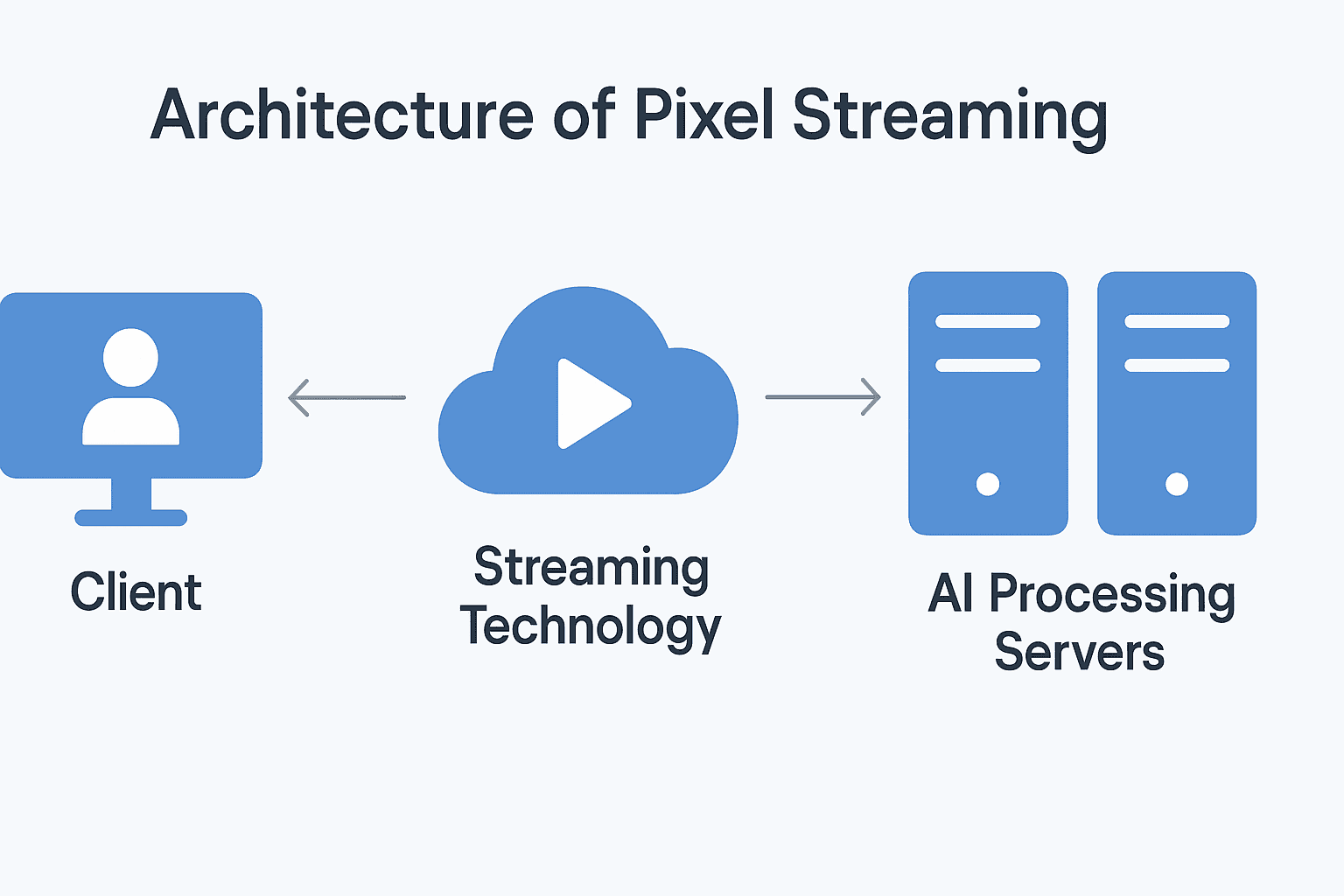
PxlPersona has built its platform on a high-speed, GPU-enabled infrastructure that combines the best of game engine performance with cutting-edge AI processing. Here’s how it works:
-
Unreal Engine GPU Machines: Our 3D avatars are rendered in real-time on machines powered by high-end NVIDIA GPUs. These machines handle the visuals, animation, lip sync, and interactive behaviours within Unreal Engine.
-
AI Processing Servers: Adjacent to the rendering nodes, we operate Linux-based AI servers running our proprietary large language models (LLMs), voice generation systems, and speech-to-text modules. Because these servers are located within our internal high-speed network, avatar conversations happen with near-zero delay.
-
Pixel Streaming Delivery: We use Epic’s reference implementation of Pixel Streaming, developed upon and fine-tuned to suit our use case — offering a seamless, low-latency pipeline between the avatar’s brain (AI) and its body (3D render), streamed directly to the user’s browser.
This tightly integrated system delivers something rare in the AI space: hyper-realistic, voice-enabled 3D avatars that respond in real-time — from the cloud, to your screen, with nothing but a browser tab.
Why This Matters
Most AI avatars today are either stuck inside 2D chat windows, or require expensive hardware and VR setups. At PxlPersona, our approach breaks that barrier:
-
A school with basic Chromebooks can access high-end, 3D avatars guiding students through mock interviews.
-
A museum with public Wi-Fi can stream famous historical figures giving AI-powered tours.
-
A jobseeker with only a mobile phone can access realistic, career coaching avatars, anytime, anywhere.
This technology reduces friction. It makes AI more accessible, more democratic, and ultimately, more impactful.

Real Use Cases: Confidence, Feedback, and Equity
We’ve already seen the power of our solution in real-world settings:
-
At our HQ, we’ve hosted in-person AI avatar training sessions, letting guests experience face-to-face interactions with conversational avatars.
-
Our Beta programme gives graduates ongoing access to our platform from home — a key stepping stone as they enter the job market.
-
One user, previously held back by confidence in interviews, used PxlPersona for practice — and landed a new, higher-paid role closer to home.
In each case, users noted the speed of interaction, the realism of the avatars, and the surprising ease of access — simply clicking a link and being face-to-face with an AI-powered, 3D persona.
Add to that the automated PDF reports summarising user performance and offering tailored feedback — and it becomes clear how far we've taken the concept of avatar-based training.
Building for the Future: Tech for Good
PxlPersona is a product of Scenegraph Studios, a team deeply committed to tech-for-good, digital equality, and AI for social impact. Our work with schools, local authorities, and individuals is driven not by novelty, but by the belief that real-time AI interactions should be available to everyone — regardless of device, postcode, or circumstance.
As we continue to refine our streaming architecture, improve avatar realism, and expand our use cases, Pixel Streaming remains the backbone of our delivery — a technology once reserved for high-end gaming, now powering life-changing experiences in education, careers, and beyond.
Get Intouch
If you’re interested in exploring how PxlPersona’s AI avatars can be deployed in your organisation, stay tuned as we release new case studies and public-facing beta trials. The future of interactive AI is here — and it streams straight to your browser.
Where Can Avatars Go Next?
AI avatars are just getting started. Explore future use cases in museums, healthcare, and more.